Missing Multiple Teeth in Lisle, IL
If several teeth in a row are gone, an implant-supported bridge is the most effective way to bring back your smile, your bite, and your confidence. Rather than leaning on adjacent teeth the way a traditional bridge does, implant bridges anchor directly to your jawbone, which preserves bone, protects surrounding teeth, and delivers a permanent, natural-looking result. At Brammeier Family Dental, Drs. Brammeier and Ericson design and place the custom bridge that completes your smile, coordinating with a trusted implant surgeon who handles the surgical placement.
What it is
A fixed bridge held in place by two or more dental implants instead of natural teeth, replacing three or more missing teeth in a row with a permanent, non-removable restoration.
Who it's for
Patients missing several teeth in a row who want a permanent, stable solution that preserves bone and leaves healthy adjacent teeth untouched.
How we help
Custom treatment planning, coordination with a trusted implant surgeon for placement, and a custom-designed bridge that matches your natural teeth, crafted and fitted in our Lisle office.
Missing teeth don't have to hold you back. An implant bridge restores your smile permanently.
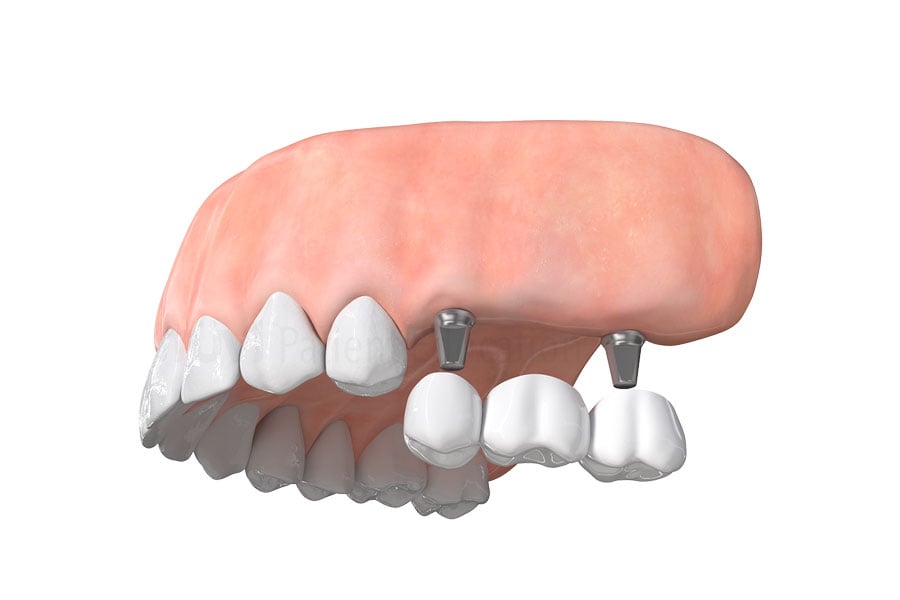
How an Implant Bridge Works
- Two or more titanium implants are set into the jawbone to act as anchors
- A custom bridge of joined porcelain crowns fastens to those implants
- In one fixed restoration, the bridge replaces three or more missing teeth
- Unlike a traditional bridge, no healthy teeth need to be filed down or crowned
- By stimulating the jawbone, the implants head off the bone loss that occurs with missing teeth
- The result looks, feels, and functions like your natural teeth

Why Replace Missing Teeth Now?
- Bone loss accelerates: With no tooth roots in place, the jawbone starts to resorb and shrink quickly
- Teeth shift: Nearby teeth drift into the open spaces, throwing off alignment and your bite
- Remaining teeth are at risk: The teeth picking up the slack carry extra stress and may also be lost
- Chewing becomes difficult: Gaps cut into your ability to eat a full range of foods
- Facial changes: Bone loss can leave a sunken, aged appearance around the jaw
- Acting sooner keeps treatment simpler and more affordable
Advantages of an Implant Bridge
- Beautiful, natural appearance: Custom porcelain crowns crafted to match your existing teeth perfectly
- Eat any food: Fixed permanently in place, an implant bridge lets you eat, bite, and chew with full confidence
- No shifting or moving: Anchored straight to the jawbone for rock-solid stability
- Preserves bone: The implants stimulate the jawbone and stave off the deterioration that comes with tooth loss
- Protects adjacent teeth: Healthy neighboring teeth are never ground down, as they would be for a traditional bridge
- Long-lasting: Cared for properly, implant bridges can last decades
The Treatment Process
- Consultation: Drs. Brammeier and Ericson assess your teeth and jawbone using digital X-rays and CT scans
- Treatment plan: We build a personalized plan around the number of missing teeth and the bone available
- Implant placement: A trusted implant surgeon we coordinate with sets titanium posts into the jawbone under local anesthesia
- Healing period: Over the next 3–6 months the implants fuse with the bone (osseointegration)
- Bridge fabrication: Custom porcelain crowns are designed and joined together to form your bridge
- Final placement: The bridge is permanently attached to the implants, completing your new teeth
An implant bridge fills the gaps without compromising your healthy teeth. Schedule a consultation today.
What to Expect at Your Visit
Visit Steps
- Evaluation: Drs. Brammeier and Ericson examine your mouth, go over your imaging, and talk through your goals and options
- Custom plan: You leave with a detailed treatment plan laying out timeline, cost, and what to expect at each stage
- Implant placement: A trusted implant surgeon we coordinate with places your implants, with sedation options available
- Progress checks: Regular follow-up visits keep an eye on healing and make sure everything stays on track
- Final restoration: After healing is complete, your custom bridge is permanently attached
Helpful Tips
- Where significant bone loss has occurred, bone grafting may come before implant placement, and we coordinate it with a trusted oral surgeon when needed
- Follow every post-surgical instruction closely to support healing
- Keep to soft foods for the first few days after implant surgery
- Keep excellent oral hygiene around the implant bridge with daily brushing and flossing
- Make every scheduled follow-up appointment
- Given proper care, your implant bridge can last for many years
Frequently Asked Questions
Our role is the restorative side of your treatment: planning your care and designing, crafting, and fitting the custom implant bridge that completes your smile. A trusted implant surgeon we partner with performs the surgical placement of the dental implants that anchor it.
With this coordinated approach, each specialist focuses on their strength while working toward the same result for you. The surgeon places the implants, then your final implant bridge is designed and fitted right here in our Lisle office, so your restoration is made to match your smile precisely.
An implant bridge does not need one implant for every missing tooth, which is part of what makes it efficient. Two implants can usually support a bridge that replaces three to four teeth in a row, because the bridge spans the gap between the anchoring implants. Longer spans or areas with heavier bite forces may call for additional implants for adequate support.
The right number for you depends on your jawbone density, the location of the missing teeth, and how many teeth are being replaced. Drs. Brammeier and Ericson will settle on the optimal number during your consultation using digital imaging, so your implant bridge has a stable, long-lasting foundation.
For most patients, an implant bridge is the stronger long-term choice. Its biggest advantage is that it stands on its own implants rather than leaning on your natural teeth. A traditional bridge requires grinding down the healthy teeth on either side of the gap to serve as anchors, which permanently alters them and can weaken them over time.
An implant bridge also preserves your jawbone by stimulating it the way natural tooth roots would, which a traditional bridge cannot do, and it typically lasts considerably longer as a result. A traditional bridge still has its place, particularly when the neighboring teeth already need crowns, but when those teeth are healthy an implant bridge protects both them and your bone.
From the first implant placement to the final bridge, the process typically takes 4 to 8 months. The bulk of that is healing time, during which the dental implants fuse with your jawbone in a process called osseointegration. This waiting period is what gives the implant bridge its lasting stability, so it is time well spent rather than a delay.
If bone grafting is needed before implants can be placed, add roughly 3 to 6 months for the graft to heal first. Drs. Brammeier and Ericson will give you a realistic timeline for your specific case at your consultation, since the number of implants and your own healing pace both shape the schedule.
Not having enough bone rarely rules out an implant bridge. Drs. Brammeier and Ericson will assess your bone density during the consultation using digital X-rays and CT imaging to see exactly how much healthy bone is available to anchor the implants.
Where bone loss has occurred, bone grafting can rebuild the area into a solid foundation for your implants. This grafting is performed by a trusted oral surgeon we partner with, and it is a common, well-established procedure that many implant patients go through. Once the graft has healed, implant placement can proceed as planned.
The cost of an implant bridge varies with the number of dental implants needed, whether bone grafting is required first, and how complex the bridge itself is. Since those factors differ from person to person, the only way to get an accurate number is a consultation and exam.
While an implant bridge is a larger upfront investment than a traditional bridge, it protects your natural teeth and jawbone and typically lasts far longer, which makes it a sound long-term value. At our Lisle office we provide a detailed estimate during your consultation and offer flexible financing options to make treatment affordable.
An implant bridge is easy to care for, because it stays fixed in your mouth and you clean it much like natural teeth. A simple daily routine keeps it and the gum tissue around the implants healthy:
- Brush twice a day, including along the gumline where the bridge meets your gums
- Clean underneath the bridge daily using floss threaders, interdental brushes, or a water flosser
- Keep up your regular checkups and professional cleanings so we can monitor the implants
With that consistent maintenance, an implant bridge can last for decades. Keeping the area around the implants free of plaque is the key to protecting your investment long-term.
Bring back your smile and your confidence. Schedule your implant bridge consultation today.