Jaw Pain Relief / TMJ Treatment in Lisle, IL
Clicking, headaches, trouble chewing, and persistent jaw pain often point to a temporomandibular joint disorder (TMD). At Brammeier Family Dental, Drs. Brammeier and Ericson draw on a range of conservative, non-surgical treatments, from custom night guards and splint therapy to therapeutic injections, to ease your pain and bring normal jaw function back.
What it is
TMD affects the temporomandibular joint (TMJ), the hinge that links your jaw to your skull, producing pain, clicking, locking, or restricted jaw movement.
Who it's for
Anyone coping with jaw pain or clicking, chronic headaches or migraines, teeth grinding (bruxism), facial tension, or a mouth that won't open fully.
How we help
A thorough clinical evaluation, digital imaging, custom oral appliances, therapeutic Botox injections, and bite adjustment, every one of them a conservative, non-surgical approach.
Letting jaw pain or clicking run your day? Lasting relief begins with a proper diagnosis.
Thinking About Botox for Jaw Pain?
Overactive jaw muscles drive much of TMJ pain, and therapeutic Botox is among the most effective ways to settle them down. Our complete guide to Botox for TMJ walks through how it works, what it treats, whether you're a candidate, and what it costs.
Signs You May Have TMD
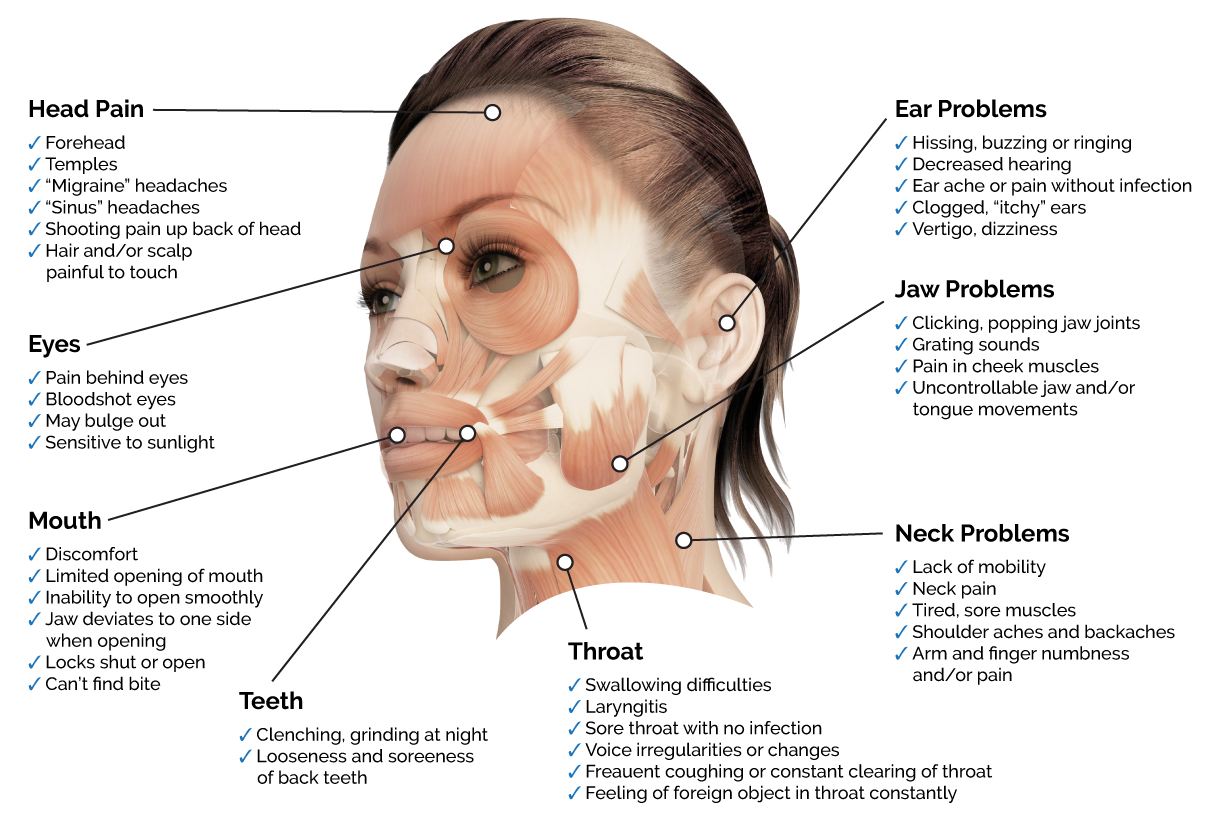
Common Symptoms
- Pain or tenderness across the jaw, face, or around the ear
- Clicking, popping, or grinding sounds as you open or close your mouth
- A jaw that locks open or locks shut
- Discomfort or difficulty when you chew
- Chronic headaches or migraines, often worst in the morning
- Ringing in the ears (tinnitus) or earaches
- Stiffness or pain through the neck and shoulders
Common Causes
- Bruxism: Ongoing teeth clenching or grinding, frequently during sleep
- Jaw injury: Trauma from an accident, sports, or a dental procedure
- Arthritis: Degenerative change within the TMJ joint
- Bite misalignment: An uneven bite loads the joint with unequal stress
- Stress: Tension fuels jaw clenching and muscle fatigue
- Disc displacement: The soft disc cushioning the joint slips out of position
Treatment Options
Night Guards & Splint Therapy
- Occlusal (night) guard: A custom plastic appliance worn while you sleep that cushions teeth against grinding and clenching
- TMJ splint: Guides the lower jaw into a position that eases stress on the joint and relaxes overworked muscles
- NTI guard: A compact appliance that covers only the front teeth. Its slim, gag-free design has proven effective at easing clenching intensity
- Every appliance is custom-made by Drs. Brammeier and Ericson for a precise, comfortable fit
- Often the first-line treatment for TMD, since it's conservative and reversible
Therapeutic Injections
- Botulinum toxin (Botox): Calms overactive jaw muscles, easing clenching force and relieving pain
- FDA-approved since 2011 to treat chronic migraine and facial pain
- With studies putting roughly 85% of TMJ pain disorders down to muscle issues, Botox proves highly effective
- Muscles keep working normally while staying relaxed enough to avoid painful contractions
- A quick in-office procedure, with results that last 3–4 months
- Dig into our complete guide to Botox for TMJ, covering how it works, what it treats, and cost
Additional Therapies
- Bite adjustment: Targeted reshaping of tooth surfaces to even out your bite
- Physical therapy exercises: Gentle stretching and strengthening moves for the jaw muscles
- Stress management: Relaxation techniques that cut down on tension-related clenching
- Medication: Anti-inflammatories or muscle relaxants for acute flare-ups
Tips for TMD Relief at Home
- Sleep on your back so you're not pressing on your jaw
- Stick to soft foods that spare you heavy chewing (yogurt, soup, scrambled eggs, fish)
- Skip chewing gum, ice, and anything hard or sticky
- Hold back on extreme jaw movements, and cradle your chin when you yawn
- Apply moist heat or an ice pack to the jaw for 10–15 minutes
- Lean on stress-reduction techniques to curb unconscious clenching
Night guards, Botox therapy, and more: we draw on several approaches to find what works best for your TMD.
What to Expect at Your Visit
Visit Steps
- Comprehensive evaluation: Drs. Brammeier and Ericson assess your jaw, bite, and muscle function while reviewing your symptoms in detail
- Imaging: Digital X-rays or other imaging may help evaluate the joint and rule out other conditions
- Diagnosis: Drawing on your exam and imaging, Drs. Brammeier and Ericson explain your specific TMD type and what's contributing to it
- Treatment plan: We talk through every option, whether appliances, injections, exercises, or a mix, then recommend a personalized approach
- Follow-up: Regular check-ins to track progress and fine-tune treatment as needed
Helpful Tips
- Track your symptoms in a journal for a week beforehand, noting when pain peaks and what sets it off
- Bring a list of every medication or supplement you take
- Because TMD usually improves a great deal with conservative treatment, surgery is rarely necessary
- A night guard can take a few nights to get used to, though most patients adjust quickly
- Mention any chronic migraines, since one treatment may tackle both issues at once
Frequently Asked Questions
The two terms get used interchangeably, but they mean different things. TMJ is short for temporomandibular joint, the joint itself, which everyone has, one on each side of the jaw where the lower jaw connects to the skull. Having a TMJ is completely normal; it is simply a part of your anatomy.
TMD stands for temporomandibular disorder, and that is the actual condition, what arises when that joint, its muscles, or the surrounding structures stop working properly and start causing pain, clicking, or limited movement. So plenty of people say 'TMJ' when they really mean 'TMD.' The distinction rarely matters in everyday conversation, and either way we know you are describing jaw pain or dysfunction, but that is the technically correct difference.
Sometimes, yes. Mild TMD flare-ups are often temporary and can settle down with some simple self-care: resting the jaw, eating softer foods for a while, applying heat or ice, and easing the stress that tends to fuel clenching. Not every twinge of jaw discomfort needs formal treatment.
What should not be ignored is TMD that is chronic, worsening, or involves clicking, locking, or persistent pain. Those symptoms usually signal an underlying problem that will not simply resolve and can advance if left alone, sometimes making later treatment more involved. As a rule, stepping in early generally leads to better outcomes, so if your symptoms keep coming back or are getting worse, it is worth having your jaw looked at rather than waiting it out.
For anyone who clenches or grinds their teeth (bruxism), a night guard ranks among the most effective and affordable treatments out there, and it does several jobs at once:
- Shields the teeth from the wear and damage of grinding
- Takes strain off the TMJ and the muscles around it
- Often eases the morning headaches and jaw soreness that come with clenching
Not everyone with TMD needs a night guard, though, and the only way to know is a proper look at your teeth and jaw. Drs. Brammeier and Ericson will check for the wear patterns and muscle signs of grinding during your evaluation and decide whether a night guard is right for you.
Yes. FDA-approved for chronic migraines since 2011, botulinum toxin injections are now widely used for TMD-related muscle pain too. The reason it works is straightforward: much of TMD pain comes from overactive jaw muscles, and Botox relaxes those muscles so they cannot clench with as much force.
By calming that muscle activity, Botox lowers clenching force and relieves the associated pain and headaches, all while the muscles keep functioning normally for eating and speaking. Results typically hold for 3–4 months before a follow-up treatment is needed, and many patients see significant improvement. Our Botox for TMJ guide has more on how it works, what it treats, and cost.
Almost never. The overwhelming majority of TMD cases respond well to conservative, non-surgical care, and that is always where we begin. Splints and night guards, Botox therapy, jaw exercises, bite adjustment, and lifestyle changes resolve or greatly improve the symptoms for the vast majority of patients.
Surgery comes into play only in the small number of cases where conservative approaches have genuinely been exhausted and significant structural damage is present in the joint itself. At our Lisle office, our whole approach is to relieve your TMD with the least invasive option that works, so surgery is very much a last resort rather than a starting point.
Many patients feel improvement within a few weeks of starting, though the full timeline depends on the approach. Night guard therapy is ongoing rather than a one-time fix; you wear the guard each night to keep protecting your teeth and joint. Botox works on its own rhythm, with results showing up within 1–2 weeks of the injections and lasting 3–4 months before a repeat treatment.
Because TMD often has more than one contributing factor, treatment is rarely a single step done once. Drs. Brammeier and Ericson will track your progress and adjust your plan as you improve, combining approaches where it helps, so the aim is steady, lasting relief rather than a quick fix that fades.
Stress is among the most common contributing factors to TMD. When you are tense, you are far more likely to clench your jaw or grind your teeth, often without realizing it and frequently during sleep. That sustained muscle activity tires and strains the jaw, and over time it wears on the TMJ, producing or worsening symptoms.
The encouraging flip side is that managing stress can meaningfully ease TMD symptoms. Relaxation techniques, regular exercise, and enough quality sleep all help reduce the unconscious clenching that drives so much of the pain. Stress is rarely the only factor, so it works best alongside other treatments like a night guard, but keeping it in check is a genuine and controllable part of getting TMD under control.
It varies quite a bit from plan to plan, and TMD coverage often spans two different types of insurance. Dental insurance frequently covers night guards and occlusal appliances, since those are dental devices, while therapeutic Botox for TMD may fall under your medical insurance when it is documented as a medical necessity rather than a cosmetic treatment.
Because the coverage can straddle both dental and medical plans, it is not always obvious what applies to your situation. We will help you make sense of your benefits before treatment begins and give you a clear estimate of any out-of-pocket cost, so the finances are settled before we move ahead with your TMD care.
Jaw pain doesn't have to be your normal. Schedule a TMJ evaluation and find out which treatment fits you best.